Words: Associations Word Game
MEGARAMAWord
4.5552.00 Reviews
- Version
- 3.2.1
- Installs
- 100.00K
- Age Rating
- Everyone
Screenshots
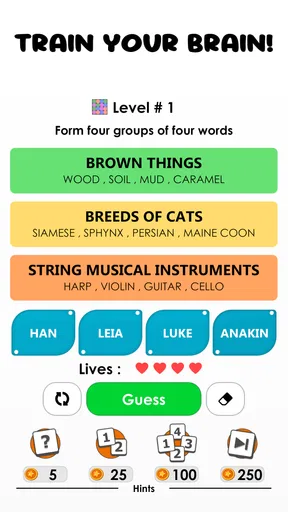
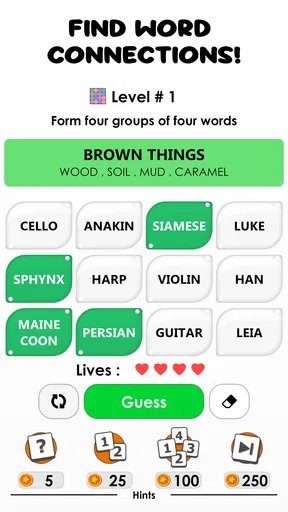
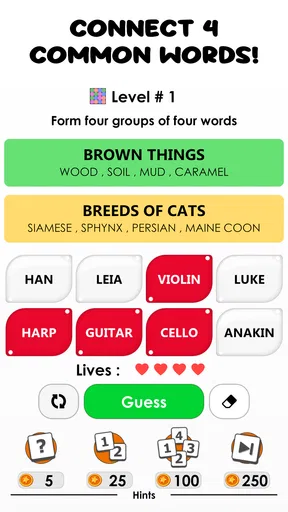
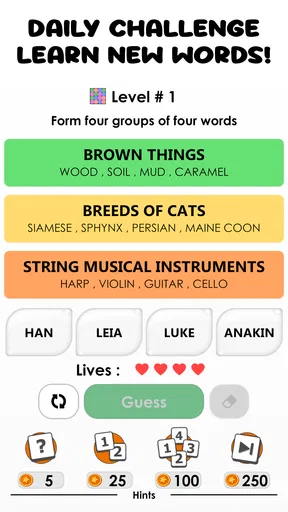
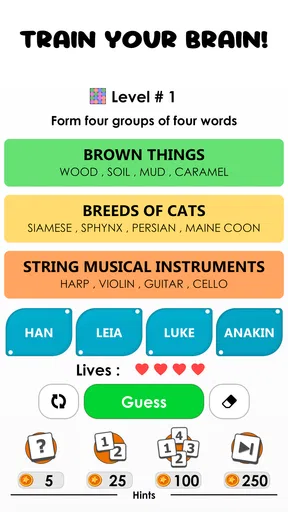
Our Review of Words: Associations Word Game
 Analysis by Appyee
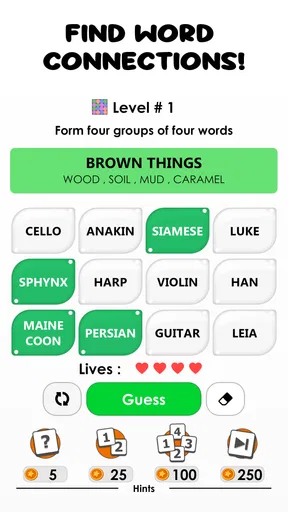
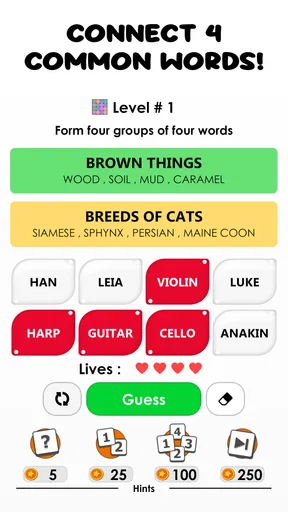
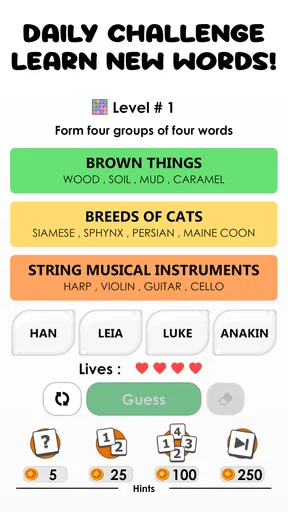
I picked up Words: Associations Word Game expecting a quick vocabulary diversion, but its simple premise gave me more to think about than I expected. The game asks me to find four words that share a connection, then use that relationship to complete a puzzle. That sounds straightforward, yet the challenge comes from separating the real link from several tempting near-matches. It is a good fit for short sessions, quiet concentration, and friendly discussion on a shared device.
Developed by MEGARAMA, this free word game sits in the word-puzzle category and is suitable for Everyone. It has reached over one hundred thousand installs and holds an average rating of 4.5 from around two thousand ratings, which matches my impression that it is easy to understand but still offers enough resistance to keep a regular player interested. The current version is 3.2.1, and it runs on Android 6.0 or later.
How it works when more than one person is playing
The most enjoyable way I used it was not as a formal multiplayer game, but as a pass-and-discuss activity. One person reads the available words, another suggests a connection, and everyone checks whether the proposed group really belongs together. That makes it work well in a living room, during a break, or whenever a phone is already being shared between people.
A realistic household example is a short evening round after dinner. One player may immediately notice a group based on meaning, while another spots a word that belongs to a category, phrase, or familiar expression. The discussion becomes part of the entertainment. I found that the best approach was to avoid grabbing the first apparent match. Instead, I asked whether the same connection applied equally well to all four words.
This shared-device style has an important limitation: the experience depends on people taking turns cooperatively. It is not the right choice if everyone wants a separate profile, a private progression path, or a competitive leaderboard-style structure. The appeal is in solving the puzzle together or comparing interpretations aloud, not in managing multiple players inside the app.
For solo use, the same design becomes a compact mental workout. I could open it for a few minutes without needing a long tutorial or a complicated setup. The daily-puzzle format also gives the session a natural stopping point. I did not feel pushed into an endless stream of levels when I only wanted one focused challenge.
Why the connections are harder than they look
The central difficulty is not simply knowing words. It is judging the strength of a relationship. Four items may appear connected because they share a broad theme, but a successful group needs a cleaner explanation. This creates a useful habit: I started testing each proposed set against the remaining words rather than celebrating the first connection that came to mind.
That habit is especially helpful for families or friends with different vocabulary strengths. A younger player may recognize a concrete category, while an adult may notice a cultural reference or word combination. Neither person has to know every answer instantly. The conversation can narrow the possibilities, and the game remains accessible without making the discussion feel like a lesson.
One practical tip is to begin with the most distinctive word rather than the easiest-looking pair. Two words can share many possible links, but an unusual item often reveals the intended group. I also found it useful to say the connection out loud in a full sentence. If the explanation sounds awkward for one of the four words, the group is probably a trap.
What to expect before installing it
The game is free to download, with in-app purchases ranging from $2.99 to $24.99 per item. That makes it easy to try without an upfront payment, but anyone sharing a device should understand that optional purchases are part of the experience. I would discuss that boundary before handing the phone to a child or leaving the game available on a family tablet.
There is also a difference between being age-rated Everyone and being equally interesting for every age. The rating makes it suitable from a content perspective, but solving the puzzles may still depend on reading ability, vocabulary, and familiarity with certain references. A child who is still developing reading confidence may enjoy playing with an adult, while an independent younger player could find some connections frustrating.
I would not treat the game as a substitute for account separation. If several people use the same device, agree on who is simply playing and who is allowed to make purchases. The game itself is best approached as a shared activity rather than a place to maintain separate household identities. That distinction matters because a common phone or tablet can blur responsibility very quickly.
For a private personal device, the setup is pleasantly light. I could move directly into the word challenge without first learning a large collection of controls. That simplicity is one of its strengths for casual players, although people who want detailed customization may find the experience intentionally narrow.
Coordinating turns without making it complicated
When I played with another person, the smoothest method was to nominate one reader and let everyone else suggest groups. The reader keeps the screen steady, while the others focus on reasoning instead of grabbing the phone. After an attempt, we explained why the four words belonged together before moving on. This prevented the session from turning into a race to tap first.
Another useful routine is to give each player a different role. One person looks for categories, another checks phrases or word associations, and a third challenges weak links. This is not a built-in team system; it is simply a way to make the shared experience fairer. It also reduces the chance that the fastest speaker controls every puzzle.
For children and adults playing together, I would avoid supplying the answer too quickly. A better hint is to ask whether two words describe objects, actions, topics, or parts of a phrase. That keeps the child involved and turns a difficult puzzle into guided reasoning. The game works particularly well here because the answer depends on relationships, not just spelling speed.
On the other hand, coordination can expose one of the game’s weaknesses. If one player already knows the intended connection, the puzzle may become less satisfying for everyone else. I recommend letting the person who spots a likely group explain it without immediately selecting it, giving the others a moment to test the idea. That small rule preserves some of the discovery.
Where it fits among other word games
Compared with a crossword, this game feels less dependent on filling a grid and more focused on classification. I do not need to maintain a long chain of intersecting answers, so it is easier to start and stop. Compared with a spelling game, it places less emphasis on speed and more on interpretation. A strong speller may still struggle if the connections are too broad, while a thoughtful player can succeed by spotting relationships.
It also differs from a traditional anagram game. Rearranging letters is not the main task here; the challenge is deciding what several words have in common. That makes it a better option for someone who enjoys language and lateral thinking but does not want every session to become a test of rapid word formation.
Daily puzzle structure gives it a more contained rhythm than an unlimited arcade-style word game. I liked that because it encouraged me to think carefully instead of tapping through a large backlog. Players who want constant variety, extensive customization, or a long campaign may prefer a broader word-game collection. This one is more focused, and that focus is both its identity and its limitation.
Small strategies that improve the experience
My first useful strategy was to separate certainty from possibility. I treated a pair of related words as a clue, not as proof. Then I searched for two more words that matched the same idea with equal precision. This prevented me from forcing an attractive but incomplete category.
A second strategy was to watch for words with more than one role. A word may appear to fit one group while actually serving as the misleading bridge to another. When a puzzle seems almost solved too early, I deliberately looked for a different interpretation before committing. That extra pause made difficult rounds feel more logical and less random.
A third strategy is valuable in a household setting: explain the connection in plain language before celebrating it. If a child or another player cannot understand why the set works, the group may be too vague. This turns the game into a conversation about language rather than a private act of guessing, and it helps reveal whether everyone is using the same meaning.
I also recommend treating a failed attempt as information. Instead of immediately trying another random combination, I reviewed which word seemed least secure. Removing the weakest assumption usually made the next attempt more productive. That approach is especially helpful for players who become annoyed when several plausible groups compete for attention.
Who should use it, and who should skip it
I would recommend this game to people who enjoy wordplay, category puzzles, and discussions about meaning. It suits a commuter looking for a brief mental break, an adult who wants a calm daily challenge, or a household that likes passing one device around. It is also a good choice for players who prefer reasoning over reflexes.
I would be more cautious about recommending it to someone seeking a deep solo progression system. The appeal comes from the individual puzzle and the quality of the connection, not from a large role-playing structure or a detailed personal journey. Likewise, anyone who dislikes ambiguity may find the near-matches irritating, especially when several words appear to belong together.
It may not be ideal for a very young independent reader, even though the content rating is Everyone. The practical question is not only whether the material is appropriate, but whether the player can comfortably read the words and understand the relationships. Shared play with an older sibling or adult can solve that problem, while unsupervised use may be less rewarding.
People who want strict household controls should also think carefully about device access and purchase responsibility. The free entry point is convenient, but shared-device use works best when the owner sets a clear rule about optional spending. I would not hand over a family tablet casually without first deciding who can approve an in-app purchase.
My household verdict
After spending time with it, I see this as a focused word game with a particularly strong social side. It does not need elaborate features to create conversation: the four-word structure naturally invites people to defend, question, and refine their ideas. That makes it more engaging in a group than its compact format might suggest.
Its main trade-off is equally clear. The experience is deliberately centered on solving connections, so players wanting extensive personalization, separate household profiles, or a large competitive framework should look elsewhere. The game is at its best when the goal is one thoughtful puzzle, not a complicated long-term system.
MEGARAMA has kept the entry barrier low, and the free download makes trying it straightforward. Optional purchases mean I would still establish a spending boundary on a shared device, particularly when children are involved. The Everyone rating supports family-friendly use, but reading level and vocabulary remain important practical considerations.
My recommendation is simple: install it if you enjoy language puzzles and want something that works alone or as a pass-and-discuss activity. Start by testing connections rather than trusting the first pair, let each player explain their reasoning, and use the daily challenge as a natural stopping point. For my household, that combination of short sessions and genuine discussion is what makes the game worth keeping around.
Verdict
Strengths of Words: Associations Word Game
- Simple rules make it easy to start playing immediately.
- Short rounds are ideal for quick breaks or casual sessions.
- Improves vocabulary and encourages creative word connections.
- Clean interface keeps attention focused on the puzzle.
- Playable at your own pace without requiring fast reactions.
Limitations of Words: Associations Word Game
- Some clues may feel subjective and have more than one valid answer.
- Difficulty can vary noticeably between puzzles.
- Repeated word themes may reduce the sense of discovery over time.
- Progress may feel limited for players seeking deeper challenges.
- Hints or extra features may be restricted by ads or in-app purchases.
Other Releases by MEGARAMA
View All
PixelPhrase ™ Pics & Word Game
Trivia4.6
Similar Picks in This Category
View All
Word Search - Word Puzzle Game
Bluetile4.8

Word Search Quest - Puzzles
Blackout Lab4.8

CodyCross: Crossword Puzzles
Fanatee, Inc.4.7

Words of Wonders: Crossword
Fugo Games4.9

Wordscapes: Word puzzle game
PeopleFun4.7

Word Search Explorer
PlaySimple Games4.9
Frequently Asked Questions
What is Words: Associations Word Game?
Words: Associations Word Game is a vocabulary and word-association puzzle in which you connect related words, ideas, or concepts to solve each challenge. Instead of simply finding hidden letters, you need to understand how terms are connected and group them logically. It is designed for short, relaxing sessions while still testing your language skills, concentration, and ability to recognize patterns.
How do you play Words: Associations Word Game?
Each puzzle presents a selection of words that appear to be mixed together. Your task is to identify the hidden relationships between them and place words into the correct associations or groups. Some connections are obvious, while others require lateral thinking or knowledge of common expressions. As you progress, the puzzles generally become more challenging and encourage you to consider several possible meanings before committing to an answer.
Is Words: Associations Word Game suitable for beginners?
Yes, the game is generally accessible to beginners because its basic concept is easy to understand and the early puzzles help you learn how the associations work. However, later levels may require a broader vocabulary, careful reasoning, and familiarity with phrases, categories, or cultural references. Players who are still improving their English can use it as a fun practice tool, although some answers may be difficult without hints or outside assistance.
Does Words: Associations Word Game require an internet connection?
The need for an internet connection can depend on the version of the app and the feature you are using. Core puzzles may be available to play offline after installation, but advertisements, cloud synchronization, daily challenges, updates, or other online services may require connectivity. Before downloading, it is worth checking the current store description and testing the game in airplane mode if offline play is important to you.
Are there hints, advertisements, or in-app purchases in the game?
Words: Associations Word Game may include optional hints to help when a puzzle becomes particularly difficult, and these assistance features can be connected to an in-game currency or rewarded advertisement system. Free versions of word games commonly display ads between rounds or after requesting help, while additional purchases may remove advertising or provide extra resources. Review the app-store listing and purchase details before downloading, especially if you prefer an uninterrupted experience.
Play our best games!


